
Czech
This screen is the area where the checks and bills of the business are recorded in the system with all their detailed information.
CHECK TYPES
• Check Entry It is the process in which the checks received by the business from customers are recorded in the system. It is taken into the portfolio to be collected. •Check Out It is the process where the business gives its own checks to suppliers or third parties. It is used for payment purposes. • Check Issuance Bank Collection It refers to the process of collecting the received checks by giving them to the bank. The check is sent to the bank and the collection process begins. • Check Out Bank Guarantee It is the process of giving checks to the bank as collateral. It is often used for credit or financial transactions. • Transaction Payroll Customer Check It is the process in which checks received from customers are processed collectively as payroll. It provides bulk tracking of checks. • Transaction Payroll Our Own Check This is the area where the checks issued by the business are processed collectively in the form of payroll. CHECK VOUCHER CARD SCREEN
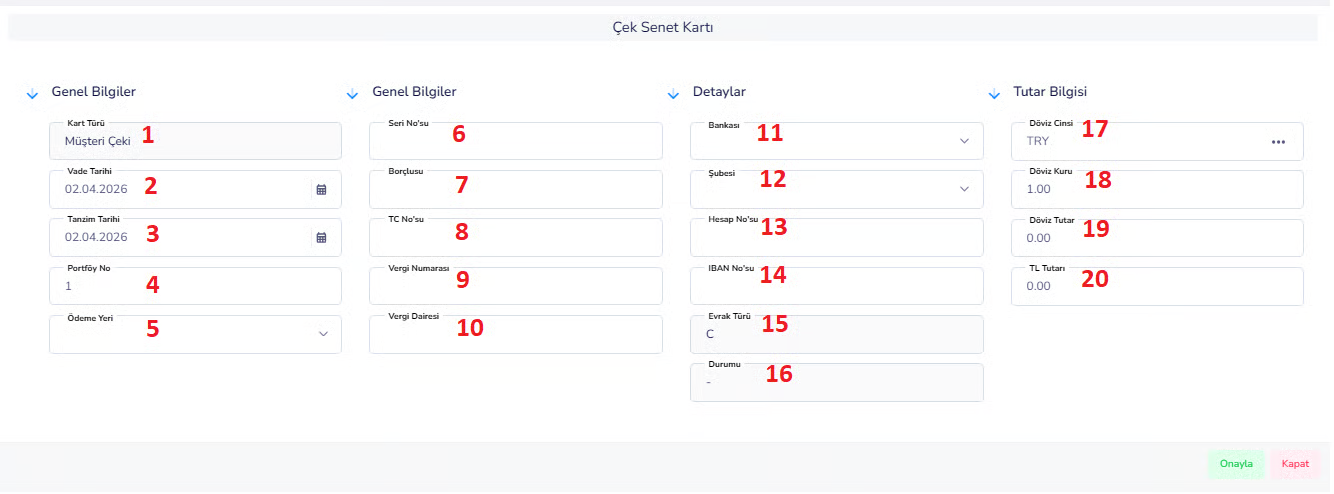
This screen is the area where the checks and bills of the business are recorded in the system with all their detailed information.
All information such as the type of check or bill, maturity date, debtor information, bank information and amount are entered on this screen. In this way, checks and bills are tracked on the system in an orderly and controlled manner. General information: 1. Card Type:Indicates whether the record is a check or a promissory note. Example: Customer Check, Promissory Note 2. Maturity Date:The date on which the check or promissory note will be collected or paid. It is a critical area for financial planning. 3. Issuance Date:The date the check or promissory note is issued. Shows the creation time of the document. 4. Portfolio Number:The portfolio number that includes the check or promissory note. It is used for mass tracking operations. 5. Place of Payment:The bank or branch information where the check or promissory note will be paid. It is important in the collection process. 6. Serial Number: It is the unique serial number of the check or bill. It is used for tracking and verification purposes. 7. Debtor:The person or company that will pay the check or promissory note. 8. TR ID Number: If the debtor is the TR ID Number: identification number is entered. 9. Tax Number:If the debtor is a company, the tax number is entered. 10. Tax Office:This is the tax office to which the debtor company is affiliated. Details: 11. Bank:Indicates the bank to which the check belongs. 12. Branch:The bank branch to which the check is attached. 13. Account Number: This is the bank account number to which the check is linked. 14. IBAN Number: It is the international bank account number. It is important for banking transactions. 15. Document Type: It refers to the type of the document in the system. Example: Check (C), Promissory Note (S) 16. Status: Shows the current status of the check or bill. Example: In Portfolio, Collected, Unpaid Amount information 17. Currency Type:Indicates the currency in which the transaction is made. Example: TRY, USD, EUR 18. Exchange Rate:The exchange rate information used in foreign currency transactions. 19. Foreign Currency Amount:The amount of the check or promissory note in foreign currency. 20. TL Amount: It is the Turkish Lira equivalent of the check or promissory note. It can be calculated automatically by the system. It is of great importance to enter complete check and promissory note information. In particular, maturity and amount errors can create financial risks. Bank and debtor information must be entered correctly. This screen is the area where checks and promissory notes are recorded and tracked in the system with all their details. Financial documents are regularly monitored and managed by entering maturity, debtor, bank and amount information.Check Promissory Card (Transfer) Explanation:
Rollover means transferring a check or bill from the previous period to the new period. In this case, the check or promissory note was not created in the current period, but continues to be actively used by transferring it from the previous period.Basic logic:
- Concept of Transfer:Transfer is the transfer of financial documents remaining from the previous period and not yet closed to the new period.
- Period Transition Example:When a year ends (for example, 2025) and the new year begins (2026), uncollected checks and bills are transferred to the new period.
- Purpose: To ensure that the tracking of transferred checks and bills continues uninterruptedly.
- Period Transitions Used at the end of the year when transitioning to a new period.
- Opening Records It is used to add existing checks/bills to the system in newly opened systems or at the beginning of a new period.
- Data Entry from the Past It is used for old dated checks and bills that are entered into the system later.
- Not a New Transaction: The record marked as a transfer is not a new financial transaction.
- It Works in the Opening Logic: In accounting, it is generally considered as the opening balance.
- Does not create income/expense: Does not create income or expense records again.
- Represents Continuing Existence: It only indicates that the current financial document continues.
CHECK ISSUE TRANSACTION TYPES
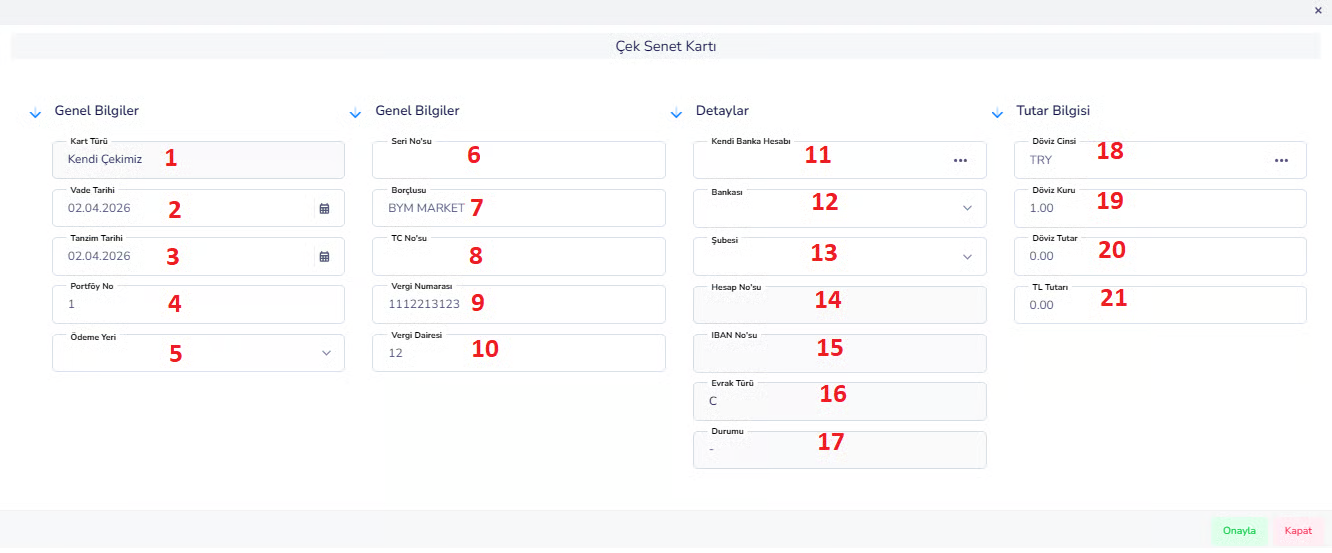
ISSUE OF OUR OWN CHECK (GIVING A CHECK)
-
- Exchange Rate: Exchange rate information
-
- Foreign Currency Amount:Foreign currency based amount
-
- TL Amount: Turkish Lira equivalent
OUTPUT OF OUR CUSTOMER CHECK (TURNOVER)
Description
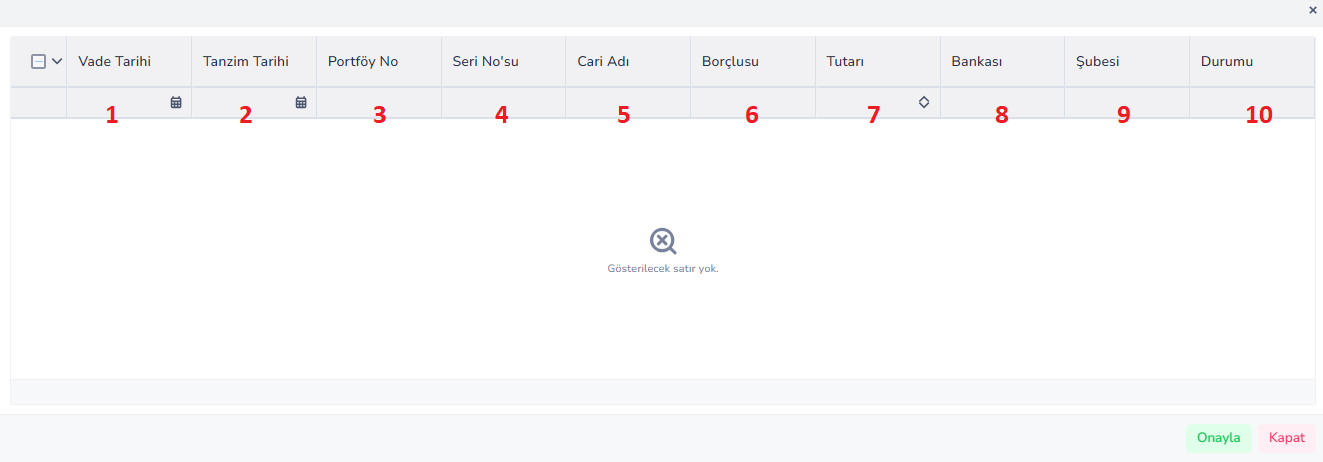
Customer check issuance (endorsement) process refers to the business transferring the checks it receives from customers to another person or company without collecting them. As a result of this transaction, the check is removed from the business's portfolio and transferred to the new creditor, and the business pays its relevant debt by check instead of cash. In this process, the check's maturity, amount and debtor information do not change, only the owner of the check changes.
OUTPUT OF OUR OWN CHECK (CYCLE)
Current / Company Information:
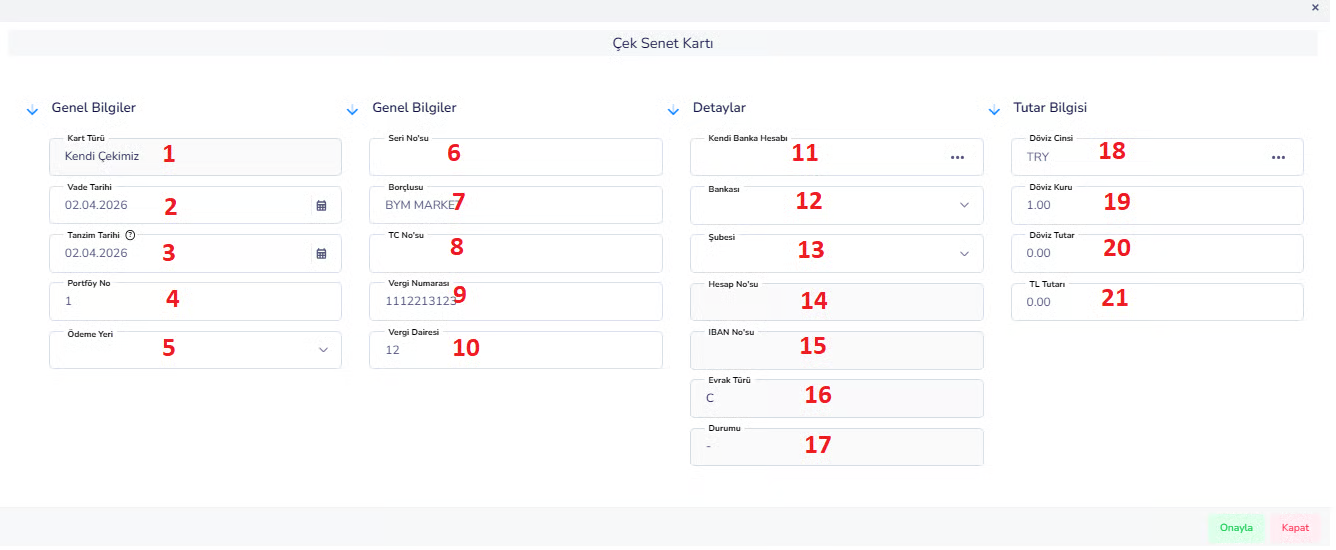
6. Serial Number: It is the serial number of the check. 7. Debtor:Indicates the person or company that will pay the check. 8. TR Number: It is the identification number of the debtor. 9. Tax Number:This is the tax number used for the company. 10. Tax Office:This is the tax office to which the company is affiliated.Bank and Detail Information:
11. Own Bank Account:This is the bank account of the company to which the check is linked. 12. Bank: This is the bank information to which the check belongs. 13. Branch: This is the branch information of the bank. 14. Account Number: Bank account number. 15. IBAN Number: It is the international bank account number. 16. Document Type:Document type (eg: Check = C). 17. Status:The current status of the check (active, closed, etc.).Amount Information:
18. Currency Type:The currency used in the transaction. 19. Exchange Rate:Exchange rate information. 20. Foreign Currency Amount: Foreign currency based amount. 21. TL Amount: Turkish Lira equivalent. What Happens After the Procedure?- The check is no longer in the business's portfolio
- It is given to the other party
- The debt is paid off or reduced
- Money comes out of the bank on the maturity date
- This check has not been newly created
- It came from the previous period
- It generally does not create a re-record in accounting
- It is just movement of the current value
CUSTOMER CHECK ISSUE (TURNOVER) (TURNOVER)
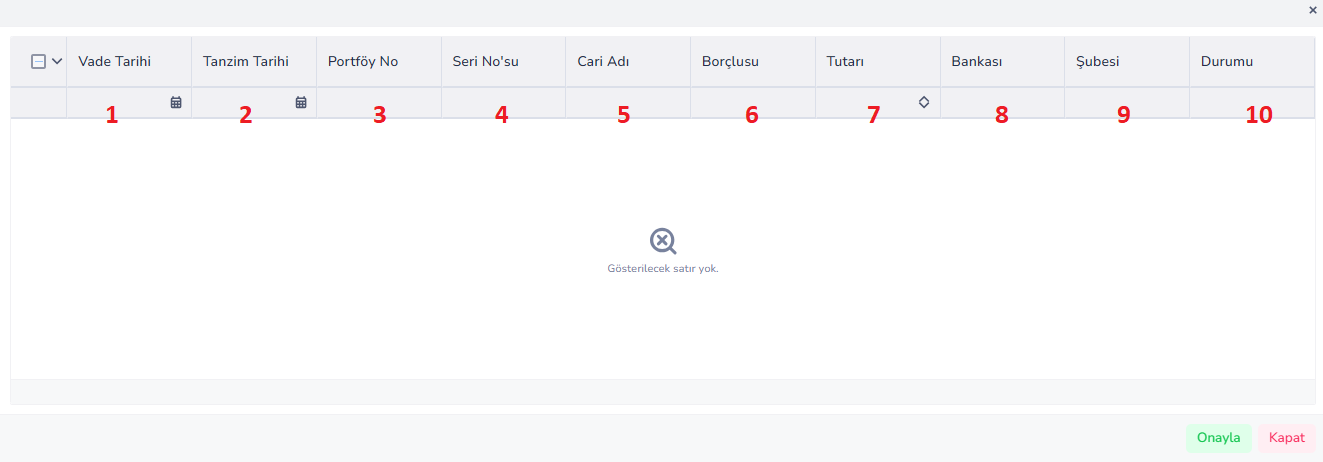
- Use of Rollover Check The customer check from the previous period is used.
- Endorsement Transaction This check is transferred to another person or company.
- Purpose: Instead of cash payment, the debt is paid off by check.
Process Steps:
- Check Selection Transfer customer check is selected from the system.
- Current Assignment The check is issued to a current account (supplier, etc.)
- Portfolio Transaction The check is removed from the portfolio.
- Transfer Check is transferred to the new payee.
Field Descriptions:
1. Maturity Date:The date on which the check will be collected. It is immutable, original information. 2. Issuance Date:The date the check is issued. It generally belongs to the old period. 3. Portfolio Number:The portfolio number to which the check is linked. 4. Serial Number: It is the unique number of the check. 5. Current Name:The person or company to whom the check is transferred. He is a new creditor. 6. Debtor:The main person or company that will pay the check. Constant. 7. Amount:The monetary value of the check. 8. Bank: / 9. Branch The bank and branch information to which the check belongs. 10. Status:The status of the check changes after the transaction. Example: Endorsed Status After the Procedure- Portfolio Status The check is removed from the company's portfolio.
- Ownership Check passes to another company.
- Cash Situation The business does not collect cash.
- Debt Status The debt is paid by check.
CHECK OUTPUT BANK COLLECTION
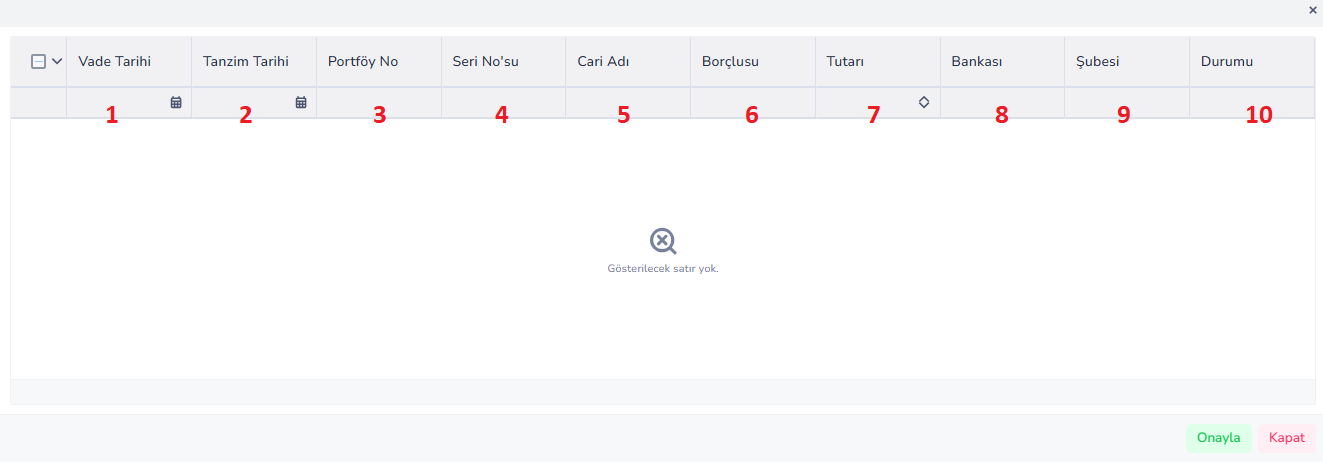
Definition of the Transaction:
It is the process of collecting the check held by the business by giving it to the bank. The check is sent to the bank and the collection process is startedWhat is Done in the Transaction?
Check is selected from the system The check is sent to the bank for collection The check leaves the portfolio and enters the banking processFields and Their Meanings:
1. Maturity Date:The date the check will be collected 2. Issuance Date:The date the check is issued 3. Portfolio Number:The portfolio number to which the check is linked 4. Serial Number:The unique number of the check 5. Client Name:The customer / client to whom the check belongs 6. Debtor:The person/company who will pay the check 7. Amount:Monetary value of the check 8. Bank:The bank where the collection will be made 9. Branch: Branch of the bank 10. Status:Transaction status of the check • Example: Collected What Happens After the Procedure?- The check no longer appears in the portfolio
- Sent to the bank
- Collection process begins
- The bank collects the money on the maturity date
Critical Logic:
- The check does not change hands in this transaction
- The bank becomes an intermediary
- If collected, the money is transferred to the account
- If it cannot be collected, it may be unrequited
Description
Check out bank collection process refers to the process of collecting the checks held by the business by giving them to the bank. As a result of this process, the check is removed from the portfolio and transferred to the bank. The bank collects the check on the maturity date and if successful, the amount is transferred to the business's account.CHECK OUTPUT BANK GUARANTEE
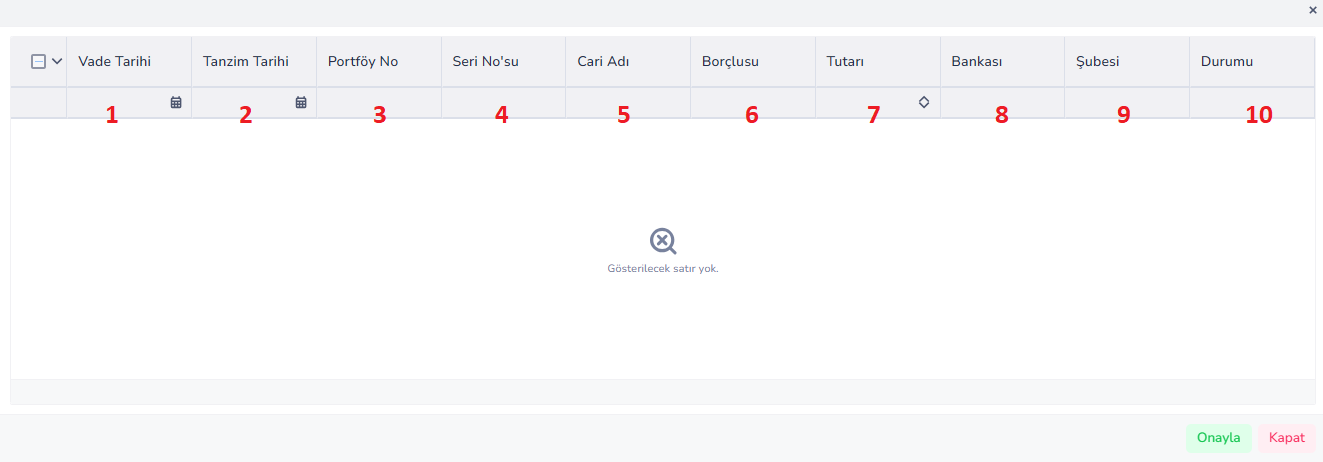
Definition of the Transaction:
Giving the check held by the business to the bank as collateral (assurance) The check is not collected, it is just deposited with the bank as security. What is Done in the Transaction? Check is selected from the system The check is given to the bank as collateral. The check is removed from the portfolio and taken into the collateral process.List Columns:
1. Maturity Date: It is the maturity (collection) date of the check. 2. Issuance Date:The date the check is issued 3. Portfolio Number:The portfolio number to which the check is linked 4. Serial Number:The unique number of the check 5. Client Name:The customer / client to whom the check belongs 6. Debtor:The person/company who will pay the check 7. Amount:Monetary value of the check 8. Bank:The bank to which it is given as collateral 9. Branch: Branch of the bank 10. Status: Transaction status of the check • Example: Guaranteed What Happens After the Procedure?- The check is removed from the portfolio
- It is given to the bank as collateral
- The business cannot use this check
- The bank keeps this check as security
- There is no money inflow in this transaction
- Cheques will not be collected
- Assurance is provided only for credit or financial transactions
Description
Check-out bank guarantee transaction refers to the checks held by the business being given to the bank for guarantee purposes. As a result of this transaction, the check is removed from the portfolio and left as security to the bank. The check is not collected and no cash flow is generated, it only serves as collateral for financial transactions.TRANSACTION PAYROLL CUSTOMER CHECK – CHECK TYPES
1. CHECK RETURN TO CUSTOMER
• It means returning the check previously received from the customer back to the customer. • It is generally done in cases such as incorrect transaction, cancellation or requesting the check back. • The check is removed from the business portfolio. • The check no longer appears in the business's hand. • Since it is delivered back to the customer, tracking responsibility passes back to the customer.2. COLLECTION OF CHECKS FROM PORTFOLIO
• The customer check held by the business is collected directly. • In other words, the check is considered to have been collected directly without going to the bank as collateral or any other transaction. • The check is removed from the portfolio. • The amount of the check is deemed to have been collected. • Current receivables are closed or reduced.3. COLLECTING A CHECK AT THE BANK
• The check received from the customer is given to the bank and entered into the collection process. • The check is no longer considered to be in the portfolio but is processed in the bank. • Collection may not occur immediately; It is tracked through the bank. • The status of the check is in collection at the bank. • Ultimately, the receivable is closed when the bank collects it.4. BONUS CHECK IN PORTFOLIO
• It is a situation where the check in the portfolio of the business cannot be collected. • It turns out that the check bounces. • In other words, payment was not received on the check's due date. • The check is not considered collected. • Current risk continues, the receivable is not closed. • If necessary, legal or financial follow-up process is initiated.5. BONUS CHECK AT THE BANK
• The check given to the bank for collection is returned dishonored by the bank. • In other words, the check was given to the bank but payment was not received. • The bank collection process of the check fails. • The check becomes bounced. • Since the receivable is not collected, the current risk continues.6. CHECK RETURN FROM CUSTOMER TO PORTFOLIO
• It is the reintroduction of a check that was previously out of the portfolio due to another transaction to the business portfolio. • For example, it can be used in correction or refund transactions with the customer. • The check begins to appear in the hands of the business again. • It is actively monitored in the portfolio. • It may be subject to subsequent collection, endorsement or return transactions.7. CHECK RETURN FROM BANK TO PORTFOLIO
• It is the return of the check given to the bank for collection or guarantee purposes to the business portfolio. • So the check has been received back from the bank. • The check no longer appears in the bank. • It is tracked again in the business portfolio. • If desired, it may be subject to re-collection, guarantee or endorsement transaction. 8. BONUS CHECK RETURN FROM CUSTOMER
• Returning the bounced check to the customer. • Instead of keeping this check, the business gives it back to the customer. • The check is removed from the portfolio. • Information on reciprocity is preserved, but physical and operational responsibility returns to the customer. • Usually a new payment request or alternative collection method comes to the fore. 9. CHECK COLLECTED FROM TURNOVER
• It is when a check previously endorsed to another person or company becomes collected. • In other words, the check was finalized through the endorsed process, not by the business. • The check is no longer an open transaction. • The debt or credit relationship is closed according to the relevant transaction. • The check is considered successful. 10. UNCOLLECTABLE CHECK
• It is the situation where payment is not received even though the check is in the collection process. • This can have similar results as a bounced check, but the processual uncollectibility is emphasized. • The expected payment from the check does not occur. • Current receivables are not closed. • The check may require additional tracking, return or legal action. 11. BONUS CHECK PORTFOLIO RETURN
• The bounced check is returned to the business to be monitored in the portfolio. • The check is re-introduced to the portfolio when it was previously in a different status. • But it is no longer considered a normal check, but a risky / problematic check. • The business keeps track of this check again. • In the next stage, a new collection negotiation, refund or legal action can be taken with the customer.General Logic Summary:
The main purpose in all of these categories is to keep track of the stage at which the check is. The system actually tracks: • Who has the check now? • Is it in the portfolio, in the bank or in the customer? • Was it collected or not? • Was it unrequited? • Was it returned? • Has the transaction been completed, does the risk remain?TRANSACTION PAYROLL OUR OWN CHECK – CHECK TYPES
1. OUR CHECKS RETURNED FROM CUSTOMER
• The check we previously gave to the customer comes back to the business. • That is, the check was not used or returned by the other party. • The check enters the business portfolio again • Reusable (payment, endorsement, etc.) • The business's control over the check begins again.2. OUR CHECKS PAID TO CUSTOMER
• The check issued by the business has been collected by the customer • In other words, the check was paid on maturity and the transaction was completed. • Check is now closed • The relevant debt of the business is paid off. • The check appears as “paid” in the systemGeneral Logic:
Focus in these categories: • Check is ours (check belonging to the business) • Given to the other party • Either returned (returned) • Or fully paid (closed)Bu doküman yardımcı oldu mu?
Eksik veya geliştirilmesi gereken bir bölüm varsa destek ekibimizle paylaşabilirsiniz.