
promissory note
It is the use of the debt security transferred from the previous period for payment purposes in this period. The bill belongs to the old period, the transaction is made in this period. What is done in the process?
BILL CARD SCREEN
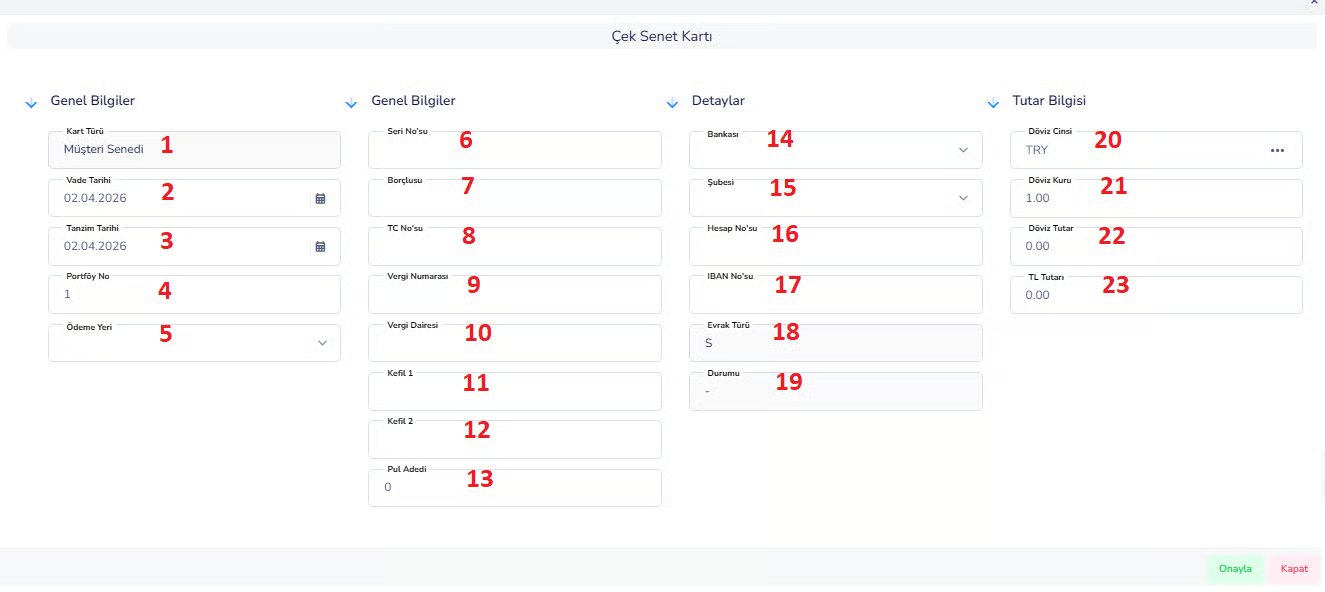
General Information:
1. Card Type:Indicates the bill type (customer bill, etc.). 2. Maturity Date:The date on which the bill will be paid. 3. Issuance Date:The date the promissory note was issued. 4. Portfolio Number:The portfolio number to which the bill is linked. 5. Place of Payment:The bank or place where the bill will be paid. 6. Serial Number: It is the unique number of the bill. 7. Debtor:The person or company that will pay the bill. 8. TR Number: If the debtor is the person, it is the identification number. 9. Tax Number:If the debtor is a company, it is the tax number. 10. Tax Office:This is the tax office to which the debtor company is affiliated. 11. Guarantor 1:The first guarantor responsible for the promissory note. 12. Guarantor 2:The second guarantor responsible for the promissory note. 13. Number of Stamps: It is the stamp/stamp information on the bill.Details:
14. Bank:The bank to which the bill belongs. 15. Branch: It is the bank branch to which the bill is attached. 16. Account Number: Bank account number. 17. IBAN Number: It is the international account number. 18. Document Type:Indicates that the document is a promissory note (S). 19. Status:The current status of the bill.Amount Information:
20. Currency Type:Specifies the currency of the transaction. 21. Exchange Rate:Exchange rate information for foreign currency transactions. 22. Foreign Currency Amount:The amount of the bill in foreign currency. 23. TL Amount: It is the Turkish Lira equivalent of the bill.BILL CARD (TRANSFER) DESCRIPTION
The promissory note card (transfer) is the transfer of the promissory notes from the previous period, which have not yet been closed, to the new period. This bill: • It was not created in this period • It existed before • It was transferred to the new period because it was not collectedBasic Logic:
- Transfer Definition:Transfer is a process that works like an opening record.
- Transaction Status: It is not a new transaction. It simply represents the continuation of the existing bill.
- Period Transition: Used at the end of the year when transitioning to a new period
- Later Data Entry: Used when adding past bills to the system.
- System Transitions: Used to transfer data from the old system to the new ERP system.
- Normal Promissory Note: It is a new transaction. It creates current movement. Makes records in accounting.
- Deed of Transfer: It is not a new transaction. Generally, it does not re-register in accounting. It only carries the balance.
Example:
Scenario: In 2025, a promissory note of 20,000 TL was received from the customer. Maturity date: June 2026 New Period: When the year 2026 is passed, this bill is transferred to the system as a "transfer". Transfer Note: It is the note that is transferred from the previous period and is still open.ISSUE OF OUR DEBIT
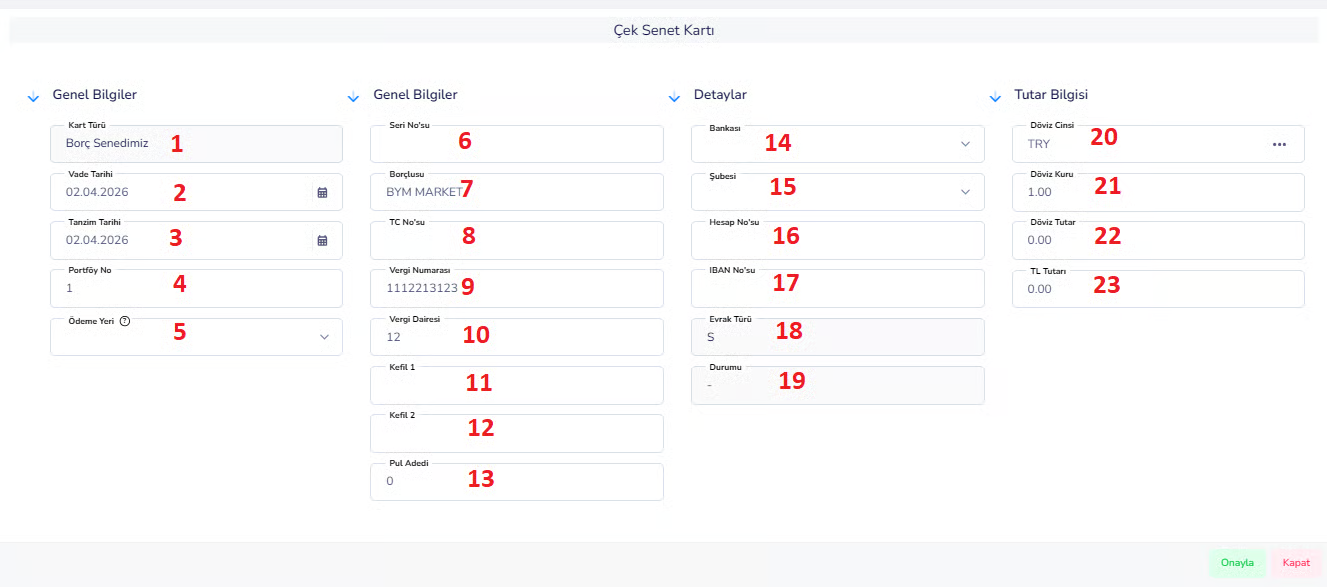
What is Done in the Transaction?
Debt note is created through the system This bill is given to the relevant current account (supplier, etc.). The bill leaves the portfolio and passes to the counterpartyFields and Their Meanings:
1. Card Type:Our Debt Note is selected. 2. Maturity Date:The date on which the bill will be paid. 3. Issue Date:This is the issue date of the bill. 4. Portfolio Number:The portfolio number to which the bill is linked. 5. Place of Payment:The place / location where the bill will be paid.Current / Debtor Information:
6. Serial Number:The unique serial number of the bill. 7. Debtor:The party (business) that will pay the bill. 8. TR Number: It is the identification number of the debtor. 9. Tax Number:The tax number of the debtor. 10. Tax Office:This is the tax office to which the debtor is affiliated. 11. Guarantor 1:The person who is guaranteed the deed. 12. Guarantor 2:The second guarantee is the person. 13. Number of Stamps: It is the stamp information on the bill.Details:
14. Bank: The bank to which the bill is affiliated.
15. Branch:Bank branch information.
16. Account Number:It is the account number.
17. IBAN Number: IBAN information.
18. Document Type:S → Indicates that it is a promissory note.
19. Status:The current status of the bill (eg: Issued).Amount Information:
20. Currency Type:The currency of the transaction (TRY etc.). 21. Exchange Rate: Exchange rate information if there is a foreign currency transaction. 22. Foreign Currency Amount: Foreign currency based amount. 23. TL Amount: TL equivalent of the bill. What Happens After the Procedure?- The promissory note is given to the other party
- The business's debt is paid off or reduced
- No immediate cash outflow
- Payment takes place on the due date
- In this transaction, the money does not come out immediately
- Note is a deferred payment instrument
- The business promises to make payments in the future
CUSTOMER BILL ISSUE (TURNOVER)
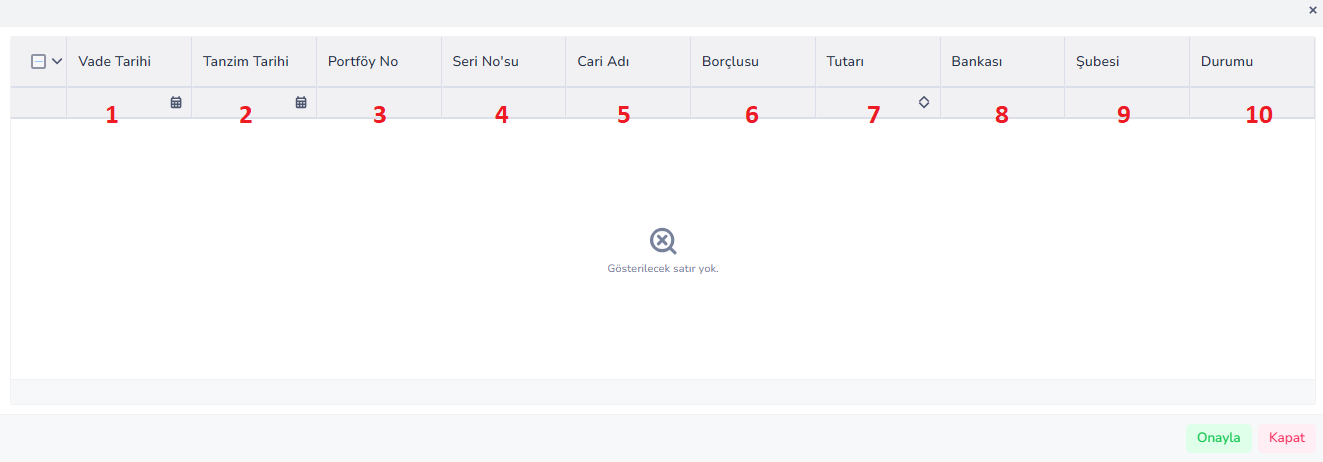
Fields:
1. Maturity Date:The date on which the bill will be paid. 2. Issuance Date:The date the promissory note was issued. 3. Portfolio Number: It is the portfolio number to which the bill is linked. 4. Serial Number: It is the unique number of the bill. 5. Current Name:The person or company to whom the bill is transferred. 6. Debtor:The main person/company who will pay the bill. 7. Amount:The monetary value of the bill 8. Bank / Branch: Bank and branch information to which the bill is linked 9. Status: Shows the status of the bill after the transaction. What Happens After the Procedure?- The bill is removed from the business's portfolio
- Transfers to another company
- The business does not collect cash
- He pays his debt with a promissory note
- There is no money inflow in this transaction
- The promissory note only changes hands
- This is a payment/exchange method
Description
Customer bill issue (endorsement) process refers to the business transferring the bills it receives from customers to another person or company without collecting them. As a result of this transaction, the bill is removed from the company's portfolio and transferred to the new creditor. The maturity, amount and debtor information of the promissory note remain unchanged and the business pays its relevant debt with promissory notes instead of cash.ISSUE OF OUR DEBT DEBIT (Transfer)
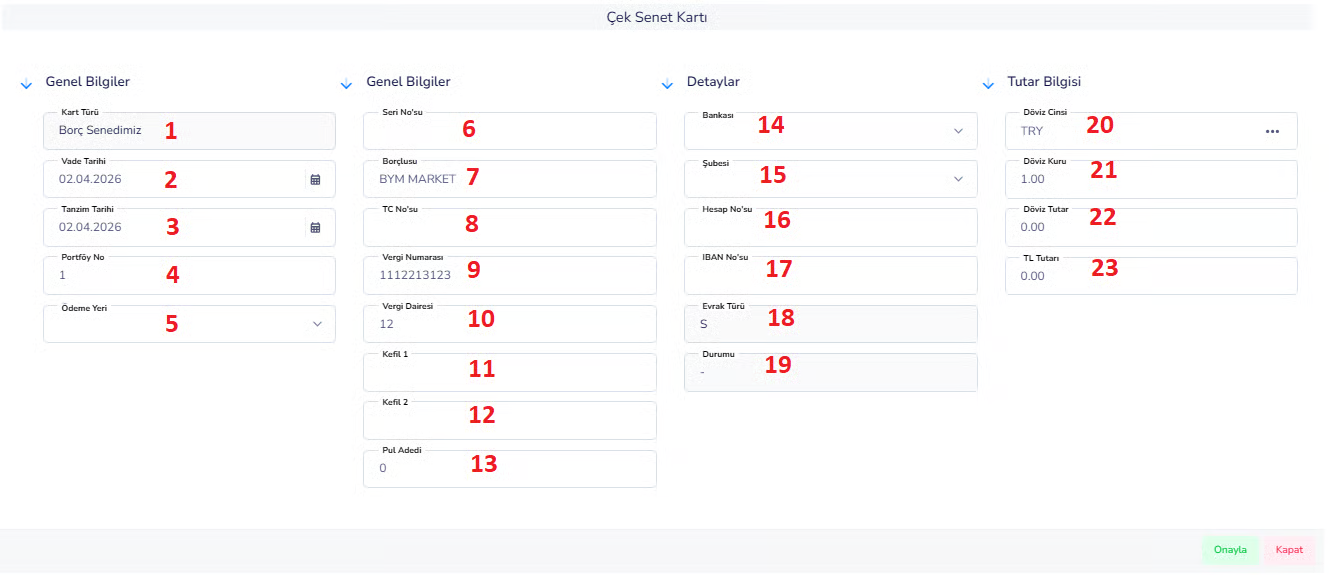
Definition of the Transaction:
It is the use of the debt security transferred from the previous period for payment purposes in this period. The bill belongs to the old period, the transaction is made in this period.
What is Done in the Transaction?
Transfer debt note is selected from the system This bill is given to the relevant current account (supplier, etc.). The note is removed from the portfolio Payment transaction is completedFields:
1. Card Type:Our Debt Note 2. Maturity Date: Payment date of the promissory note 3. Date of Issuance:Date of issuance of the bill 4. Portfolio Number:Portfolio number of the bond 5. Place of Payment:The place where the bill will be paid 6. Serial Number: Serial number of the bill 7. Debtor:The party who will pay the bill 8. TR Number:Identity number 9. Tax Number:Tax number 10. Tax Office:The tax office it is affiliated with 11. Guarantor 1:First guarantor 12. Guarantor 2:Second guarantor 13. Number of Stamps: Bill stamp informationDetails
14. Bank:The bank to which the bill is affiliated 15. Branch:Bank branch 16. Account Number: Account information 17. IBAN Number: IBAN information 18. Document Type:S (Note) 19. Status:Transaction status of the billAmount Information:
20. Currency Type:Currency (TRY etc.) 21. Exchange Rate:Exchange rate information 22. Foreign Currency Amount: Foreign currency based amount 23. TL Amount: TL equivalent What Happens After the Procedure?- The promissory note is given to the other party
- The business's debt is paid off or reduced
- Cash outflow does not occur immediately
- Payment takes place on the due date
- This bill came from the previous period
- No new promissory note is created
- It generally does not create a re-entry in accounting
- It is only the movement of existing debt
Description
The issuance (transfer) of our debt securities is the use of debt securities transferred from the previous period and belonging to the business as payment instruments in the new period. In this process, the bill is not re-created, the existing bill is removed from the portfolio and transferred to the relevant current account. With this transaction, the business pays its debt with a promissory note and the payment is made on the maturity date.CUSTOMER BILL ISSUE (TURNOVER) (TURNOVER)
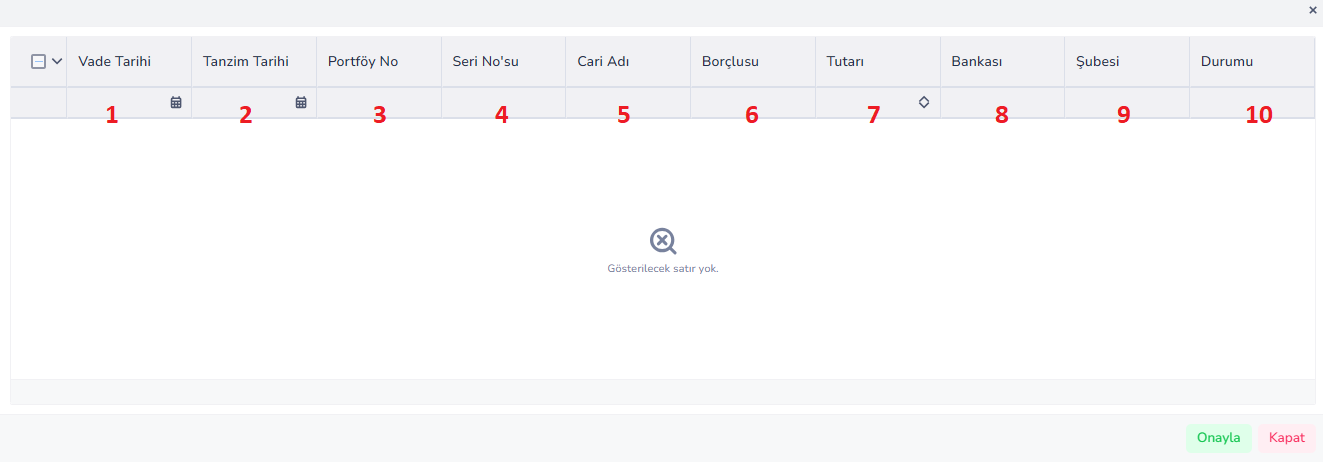
Definition of the Transaction:
It is the transfer of the customer bill transferred from the previous period to another person or company in this period. Includes both turnover and transfer
What is Done in the Transaction?
Transfer customer bill is selected from the system This bill is given to the relevant current account (supplier, etc.) The note is removed from the portfolio Transferred to the new creditorFields:
1. Maturity Date:The date on which the bill will be paid. 2. Issuance Date:The date the promissory note was issued. 3. Portfolio Number: It is the portfolio number to which the bill is linked. 4. Serial Number: It is the unique number of the bill. 5. Current Name:The person or company to whom the bill is transferred. 6. Debtor:The main person or company that will pay the bill. 7. Amount:The monetary value of the bill 8. Bank / Branch: Bank and branch information to which the bill is linked 9. Status: Shows the status of the bill after the transaction.What Happens After the Procedure?
- The bill is removed from the business's portfolio
- Transfers to another company
- The business does not collect cash
- He pays his debt with a promissory note
Critical Logic
- The promissory note came from the previous period
- No new promissory note is created
- Only ownership changes
- It generally does not create a re-entry in accounting
Description
Customer bill issue (turnover) (transfer) transaction refers to the transfer of customer bills transferred from the previous period to another person or company without being collected. As a result of this transaction, the bill leaves the company's portfolio and passes to the new creditor. The maturity, amount and debtor information of the promissory note remain unchanged and the business pays its relevant debt with promissory notes instead of cash.BILL ISSUE BANK COLLECTION
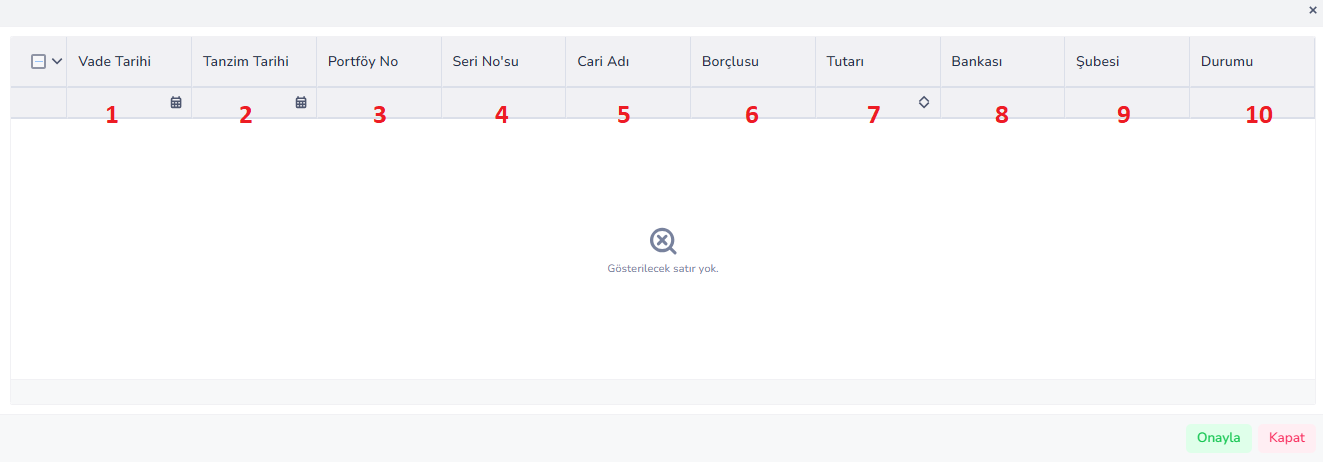
What is Done in the Transaction?
The bill is selected from the system The bill is sent to the bank for collection. The bill leaves the portfolio and enters the banking processFields:
1. Maturity Date:The date on which the bill will be collected. 2. Issuance Date:The date of issuance of the promissory note. 3. Portfolio Number: Portfolio number to which the bill is attached 4. Serial Number:The unique number of the bill 5. Client Name:The customer / client to whom the bill belongs 6. Debtor:The person/company who will pay the bill 7. Amount:Monetary value of the bill 8. Bank:The bank where the collection will be made 9. Branch:Bank branch 10. Status:Transaction status of the bill Example: CollectedWhat Happens After the Procedure?
- The bill no longer appears in the portfolio
- Sent to the bank
- Collection process begins
- The bank carries out the collection on the maturity date
Critical Logic:
- The note does not change hands
- The bank becomes an intermediary
- If collected, the money is transferred to the account
- If it cannot be collected, the transaction will fail (without compensation, etc.)
Description
Bill issue bank collection process refers to the process of collecting the bills held by the business by giving them to the bank. As a result of this process, the bill is removed from the portfolio and transferred to the bank. The bank collects the bill on the maturity date and if successful, the amount is transferred to the business's account.BILL ISSUE BANK GUARANTEE
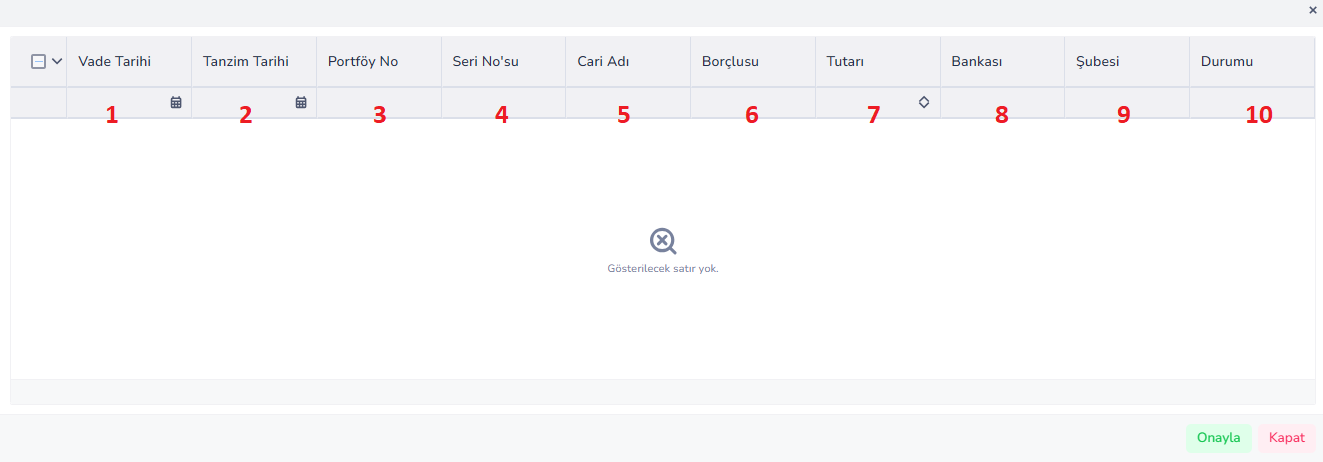
What Happens After the Procedure?
- The note is removed from the portfolio
- It is given to the bank as collateral
- The business cannot use this bill
- The bank keeps this note as security
Critical Logic:
- There is no cash flow in this transaction
- Note is not collected
- Collateral is provided only for credit or financial transactions
Description
The bill issue bank guarantee transaction refers to the giving of the bills held by the business to the bank for the purpose of guarantee. As a result of this transaction, the bill is removed from the portfolio and left as security to the bank. The promissory note is not collected and no cash flow occurs, it only serves as collateral for financial transactions.TRANSACTION PAYROLL – CUSTOMER VOUCHER TYPES
1. Return of Note to Customer
• The bill previously taken from the customer is given back to the customer. • The bill is removed from the portfolio • The business's right to the promissory note ends • Current receivables may become open again2. Bill Collection from Portfolio
• The bill is collected directly by the business • The transaction is completed without going to the bank • The bill is removed from the portfolio • The receivable is closed3. Bill Collection at the Bank
• The bill is given to the bank and put into the collection process. • The bill is removed from the portfolio and transferred to the bank. • Collection takes place through the bank • The receivable is closed when collected.4. Protested Promissory Note in Portfolio
• The bill in the portfolio is not paid on maturity. • The promissory note is protested (it is officially recorded that it has not been paid) • The bill becomes risky • The receivable has not been collected5. Protested Promissory Note at the Bank
• Promissory note given to the bank cannot be collected • The bank returns the bill with protest. • The promissory note is not collected • Current risk continues6. Promissory Note Return from Customer to Portfolio
• Bills that were previously taken out of the portfolio are put back into operation. • The bill appears in the portfolio again • Transactions can be made again (collection, endorsement, etc.)7. Return of Notes from Bank to Portfolio
• The bill given to the bank is taken back • The bill re-enters the business portfolio. • Banking process ends • The business rechecks the bill.8. Protested Promissory Note Return from Customer
• Protested (unpaid) bill is returned to the customer • The bill is removed from the portfolio • The business turns to different collection methods • Risk is left to the customer side9. Note Collected from Endorsement
• The bill was transferred (endorsed) to another company and collected • The bill is now considered closed. • Debt/credit relationship is completed10. Uncollectible Note
• The bill has entered the collection process, but payment has not been received. • The receivable is not settled • The bill becomes problematic • Additional action required (protest, refund, etc.) General Logic In these transactions, the system follows the following process: • Who has the bill? (Portfolio / Bank / Customer) • Has it been collected? • Not paid? (Protest / Could not be collected) • Is he back? • Was it transferred to someone else? OUR TRANSACTION PAYABLE BILLS
1. Our Notes Returned from the Customer
• The promissory note we previously gave to the other party is taken back. • In other words, the creditor returned the bill to the business. • The promissory note returns to the control of the business. • The debt may not have been closed yet • The bill becomes available for trading again.2. Our Promissory Notes Paid to the Customer
• The promissory note issued by the business was paid on maturity. • The bill has been collected and the transaction has been completed. • The business's debt is paid off • The bill now appears as closed in the system.3. Our Promissory Notes Protested by the Customer
• The promissory note issued by the business was not paid on maturity. • The promissory note has been protested (it is recorded that it has not been officially paid) • The business's debt continues • Legal and financial risks occur • The bill becomes problematic.4. Our Uncollectible Promissory Notes
• The promissory note has entered the payment process, but the payment has not been made • In other words, the promissory note could not be collected by the counterparty • The debt is not closed • The promissory note is considered as an unsuccessful transaction • Additional action may be required (payment, structuring, etc.) General Logic
Focus in these categories: The promissory note belongs to the business (debt note). The result given to the other party is in 4 ways:- Refund (refund)
- Paid (closed)
- Not paid → there will be a protest
- The process fails (cannot be collected)
Bu doküman yardımcı oldu mu?
Eksik veya geliştirilmesi gereken bir bölüm varsa destek ekibimizle paylaşabilirsiniz.